


» Site Map
» Home Page
Historical Info
» Find Friends - Search Old Service and Genealogy Records
» History
» QAIMNS for India
» QAIMNS First World War
» Territorial Force Nursing Service TFNS
» WW1 Soldiers Medical Records
» Field Ambulance No.4
» The Battle of Arras 1917
» The German Advance
» Warlencourt Casualty Clearing Station World War One
» NO 32 CCS Brandhoek - The Battle of Passchendaele
» Chain of Evacuation of Wounded Soldiers
» Allied Advance - Hundred Days Offensive
» Life After War
» Auxiliary Hospitals
» War Graves Nurses
» Book of Remembrance
» Example of Mentioned in Despatches Letter
» Love Stories
» Autograph Book World War One
» World War 1 Letters
» Service Scrapbooks
» QA World War Two
» Africa Second World War
» War Diaries of Sisters
» D Day Normandy Landings
» Belsen Concentration Camp
» Italian Sailor POW Camps India World War Two
» VE Day
» Voluntary Aid Detachment
» National Service
» Korean War
» Gulf War
» Op Telic
» Op Gritrock
» Royal Red Cross Decoration
» Colonels In Chief
» Chief Nursing Officer Army
» Director Army Nursing Services (DANS)
» Colonel Commandant
» Matrons In Chief (QAIMNS)
Follow us on Twitter:

» Grey and Scarlet Corps March
» Order of Precedence
» Motto
» QA Memorial National Arboretum
» NMA Heroes Square Paving Stone
» NMA Nursing Memorial
» Memorial Window
» Stained Glass Window
» Army Medical Services Monument
» Recruitment Posters
» QA Association
» Standard
» QA and AMS Prayer and Hymn
» Books
» Museums
Former Army Hospitals
UK
» Army Chest Unit
» Cowglen Glasgow
» CMH Aldershot
» Colchester
» Craiglockhart
» DKMH Catterick
» Duke of Connaught Unit Northern Ireland
» Endell Street
» First Eastern General Hospital Trinity College Cambridge
» Ghosts
» Hospital Ghosts
» Haslar
» King George Military Hospital Stamford Street London
» QA Centre
» QAMH Millbank
» QEMH Woolwich
» Medical Reception Station Brunei and MRS Kuching Borneo Malaysia
» Military Maternity Hospital Woolwich
» Musgrave Park Belfast
» Netley
» Royal Chelsea Hospital
» Royal Herbert
» Royal Brighton Pavilion Indian Hospital
» School of Physiotherapy
» Station Hospital Ranikhet
» Station Hospital Suez
» Tidworth
» Ghost Hunt at Tidworth Garrison Barracks
» Wheatley
France
» Ambulance Trains
» Hospital Barges
» Ambulance Flotilla
» Hospital Ships
Germany
» Berlin
» Hamburg
» Hannover
» Hostert
» Iserlohn
» Munster
» Rinteln
» Wuppertal
Cyprus
» TPMH RAF Akrotiri
» Dhekelia
» Nicosia
Egypt
» Alexandria
China
» Shanghai
Hong Kong
» Bowen Road
» Mount Kellett
» Wylie Road Kings Park
Malaya
» Kamunting
» Kinrara
» Kluang
» Penang
» Singapore
» Tanglin
» Terendak
Overseas Old British Military Hospitals
» Belize
» Falklands
» Gibraltar
» Kaduna
» Klagenfurt
» BMH Malta
» Nairobi
» Nepal
Middle East
» Benghazi
» Tripoli
Field Hospitals
» Camp Bastion Field Hospital and Medical Treatment Facility MTF Helmand Territory Southern Afghanistan
» TA Field Hospitals and Field Ambulances
BMH Bowen Road Hong Kong
Information about the British Military Hospital Bowen Road Hong Kong including the history of the BMH during World War Two:
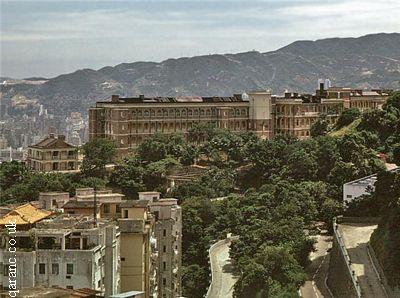
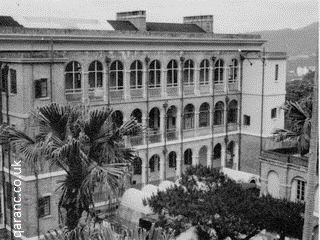
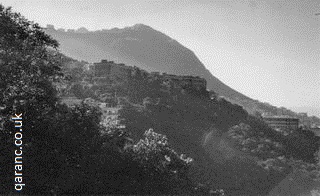
British Military Hospital Bowen Road Hong Kong opened in 1907. It was built upon a hill and had a maximum capacity of 200 beds and about 12 regular QAIMNS (Queen Alexandra's Imperial Military Nursing Service) sisters who worked alongside Canadian Army Nursing Sisters and members of the RAMC (Royal Army Medical Corps). The balconies of some of the wards overlooked the harbour giving staff and patients beautiful views.
The book Sub Cruce Candida: A Celebration of One Hundred Years of Army Nursing
 has a panoramic photo of the British Military Hospital Bowen Road, Hong Kong.
Follow us on Facebook, Instagram and Twitter.
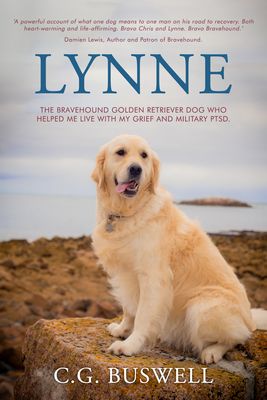
My PTSD assistance dog, Lynne, and I have written a book about how she helps me with my military Post Traumatic Stress Disorder, anxiety, and depression. I talk about my time in the QAs and the coping strategies I now use to be in my best health.
Along the way, I have had help from various military charities, such as Help for Heroes and The Not Forgotten Association and royalties from this book will go to them and other charities like Bravehound, who paired me with my four-legged best friend.
I talk openly about the death of my son by suicide and the help I got from psychotherapy and counselling and grief charities like The Compassionate Friends.
The author, Damien Lewis, said of Lynne:
"A powerful account of what one dog means to one man on his road to recovery. Both heart-warming and life-affirming. Bravo Chris and Lynne. Bravo Bravehound."
Download.
Buy the Paperback.
This beautiful QARANC Poppy Pin Badge is available from the Royal British Legion Poppy Shop.
For those searching military records, for information on a former nurse of the QAIMNS, QARANC, Royal Red Cross, VAD and other nursing organisations or other military Corps and Regiments, please try Genes Reunited where you can search for ancestors from military records, census, birth, marriages and death certificates as well as over 673 million family trees. At GenesReunited it is free to build your family tree online and is one of the quickest and easiest ways to discover your family history and accessing army service records.
More Information.
Another genealogy website which gives you access to military records and allows you to build a family tree is Find My Past which has a free trial.
Because of the hill sedan chairs were used to carry the sick from the lower levels up the hill each morning (cited in the book Queen Alexandra's Royal Army Nursing Corps (Famous Regts. S)
 by Juliet Piggott).
In 1940 Shanghai Military Hospital was evacuated and many of the QAIMNS (Queen Alexandra's Imperial Military Nursing Service) sisters were posted to BMH Bowen Road Hong Kong.
World War Two
On the 7 December 1941 Britain declared war on Japan after the Japanese bombed the American fleet at Pearl Harbor at Oahu, Hawaii on the 7 December. Though at this time the US were not involved in World War Two Japan wanted to protect their move to Singapore by destroying the US Pacific Fleet. This unprovoked attack brought the USA into WWII and Great Britain became their ally and Japan their enemy. Within hours of the declaration of war the Japanese army attacked the garrisons in Hong Kong.
A photograph of BMH Bowen Road, Hong Kong from the Second World War can be seen in The Real Tenko: Extraordinary True Stories of Women Prisoners of the Japanese
 .
.

Former Royal Air Force Regiment Gunner Jason Harper witnesses a foreign jet fly over his Aberdeenshire home. It is spilling a strange yellow smoke. Minutes later, his wife, Pippa, telephones him, shouting that she needs him. They then get cut off. He sets straight out, unprepared for the nightmare that unfolds during his journey. Everyone seems to want to kill him.
Along the way, he pairs up with fellow survivor Imogen. But she enjoys killing the living dead far too much. Will she kill Jason in her blood thirst? Or will she hinder his journey through this zombie filled dystopian landscape to find his pregnant wife?
The Fence is the first in this series of post-apocalyptic military survival thrillers from the torturous mind of former British army nurse, now horror and science fiction novel writer, C.G. Buswell.
Download Now.
Buy the Paperback.
If you would like to contribute to this page, suggest changes or inclusions to this website or would like to send me a photograph then please e-mail me.
The British troops held the garrisons as long as they could for there was no order to surrender or to retreat. War in the Far East was not expected until Britain declared war on the Japanese as an act of solidarity with America. So there was still wives and children of servicemen serving in Hong Kong and it was too late to evacuate many who wanted to stay and care for their husbands. Many had joined the VAD (Voluntary Aid Detachment) where they assisted at Bowen Road Hong Kong Military Hospital.
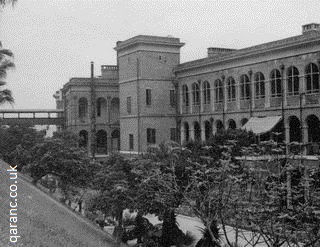
The BMH Bowen Road Hong Kong was running at full capacity at this time because a virulent strain of malaria was rife according to Quiet Heroines: Nurses of the Second World War
 by Brenda McBryde.
QA Sister Edith Dyson was the Matron of the Bowen Road Hospital and after the war Colonel Dyson became the Commandant of Queen Alexandra Camp the QARANC Depot and Training Establishment in 1950 (cited in the book Queen Alexandra's Royal Army Nursing Corps (Famous Regts. S)
by Juliet Piggott.
Theatre Sister Kathleen Thomson was the first nurse in Hong Kong to learn of Britain being at war with Japan when the duty sergeant telephoned her to say:
The CO's compliments Sister, and Great Britain has declared war on Japan.
More can be read about this Black Christmas in The Real Tenko: Extraordinary True Stories of Women Prisoners of the Japanese
.
Japan Air Attack On Hong Kong
Japan then attacked the RAF airfield and destroyed all but one plane on Hong Kong within hours of the declaration of war. The Japanese pilots then commenced an aerial attack on the Island and the first bomb hit the kitchens of British Military Hospital Bowen Road Hong Kong.
In the event of an attack upon Hong Kong there had been emergency plans to obtain extra medical supplies from the cellars of nearby St Albert's Convent on Rosary Hill. The Convent would also be used as an auxiliary hospital and was indeed opened by Lt Colonel Rudolph (RAMC) as the Commanding Officer with Sister Kathleen Thomson as acting Matron. They were assisted by 2 QAs and several VADs and members of the Chinese St John's Ambulance Brigade ( cited in Quiet Heroines: Nurses of the Second World War
).
Casualties soon arrived at both Hong Kong hospitals as a result of the bombing. Because the RAF planes had been destroyed, the Royal Navy ships nearby had been sunk and the Japanese Navy ruled the seas, there was little hope of help for the British garrison. Troops bravely defended the garrison alongside the Hong Kong Defence Corps whilst the nurses courageously attended to the wounded. The nursing staff had to work in darkness because the continual bombing had shattered windows and caused further injuries to patients. So each window was shuttered closed to protect from flying glass and the only light was from hurricane lamps though these proved dangerous to use so the nurses and doctors had to work by pocket torch.
Sister Mary Currie
As the battle continued more hospitals were opened to cope with the increased wounded. These were at the Jockey Club, the Hong Kong Hotel, the St Stephen's Boys' School at Stanley and the University. These were staffed by QAs from Bowen Road such as Sister Mary Currie who was later awarded the RRC. She was later moved to the temporarily hospital at St Albert's Convent when Sister Kathleen Thomson was seriously wounded when a shell fell when visiting the temporarily Sisters Mess for a hot meal. Sadly the same bombardment killed Sister Brenda Morgan. Sister Kathleen Thomson was evacuated to the civilian Queen Mary's Hospital in Hong Kong for an emergency operation.
In the book Women Who Went to War
 by Eric Taylor she is called Matron Kathleen Thomas and he describes how astonished she was that the Japanese troops were able to overrun the British Army:
I shall never forget my first sight of our Japanese conquerors; grubby little men, with bicycles, in dirty khaki uniform and white tennis shoes, wearing tin hats. Surely, I thought, a British garrison cannot have surrendered to men like these?
First Japanese Troops to Enter Hong Kong
The bombing continued until the 18 December 1941 when the first Japanese troops entered Hong Kong from the mainland. Their first target was the water supply of Hong Kong and they achieved this by capturing the main water reservoir. This made life within the hospitals harsh and medical supplies were restricted after ten RAMC personnel were killed by the Japanese troops at the medical supply base.
A wounded Japanese General was admitted to the St Albert's Convent British Military Hospital suffering from wounds to his buttocks on the 22 December. He was given emergency transfusions but unfortunately he died. Sister Currie and a VAD treated the body with the same respect as any other body and tried to adhere to the customs and traditions of the Japanese dead. Sister Currie found a Rising Sun flag in the General's pack and used this to wrap around his body after it had been washed and dressed and his rank insignia pinned to his chest.
Atrocities By The Japanese Troops
The next day a doctor ran into theatre and announced The Japs are here. Sister Currie was assisting the surgeon and without a thought for her own safety grabbed her helmet and ran to her young nurses. She was met by armed Japanese troops with fixed bayonets and was captured and tied up and taken outside. She was hit by a Japanese soldier with his rifle butt who tripped over her legs. She became angry and berated him for not obeying the Geneva Convention for their prisoners of war who were medical personnel. This attracted the attention of a Japanese officer who had been educated at Oxford University. She informed him that she had tried her utmost to respect his dead General. She took him to the General's body in the mortuary. Looking from the body to the English woman the officer asked Do Englishwomen never cry? To which Sister Mary Currie replied Not when they have work to do (cited in the book Sisters In Arms: British Army Nurses Tell Their Story
 .
.
The officer was so impressed by her behaviour that he left Sister Mary Currie in charge of the temporarily hospital whilst he would remain to ensure the safety of her fellow nurses. These were the only nurses at Hong Kong to escape the atrocities by the Japanese troops and many of the VADs wrote to the QAIMNS Matron in Chief after the war and to tell her about the courage of Sister Mary Currie and she was awarded the Royal Red Cross medal. The letter survives at the AMS Museum and is cited in the book Sisters In Arms: British Army Nurses Tell Their Story
.
The book Sisters In Arms: British Army Nurses Tell Their Story
has extracts from the diary of Sister Mary Currie that she was able to keep during this time.
Staff and patients at the other hospitals on Hong Kong Island did not have such security and were victims of many brutal attacks. Nurses were raped, patients murdered in their beds and much looting took place, especially alcohol stores. RAMC officers like Captain Whitney and Dr George Black who tried to stop such atrocities by the Japanese troops were shot dead and their bodies mutilated by the bayonets of the Japanese soldiers. One nurse tried to stop a Japanese soldier from ripping off the dressings of a wounded British soldier and both were bayoneted together Quiet Heroines: Nurses of the Second World War
.
St Stephen's Hospital
The first person to be killed at St Stephen's was 65 year old Dr Black who was the civilian superintendent (cited in the book Women Who Went to War
by Eric Taylor). Dr Black was a veteran of World War One and stood in the doorway in an attempt to halt the drunken Japanese troops entering the hospital. He was shot in the chest and bayoneted to death.
Fifty six British personnel were killed within a thirty minute drunken rampage at St Stephen's Hospital though some patients were able to hid in cupboards despite their painful wounds and injuries. Nurses, still thinking of their patients rather than their own safety, had been able to hide patients before the arrival of the Japanese army. When the Japanese arrived the QA nurses were targeted and repeatedly raped over Christmas Eve and Christmas Day. One patient who had been hidden by the nurses was Lance Corporal Harding of the Middlesex Regiment who had bad injuries to both legs. He was hidden in a wicker laundry basket and had to watch helplessly through its slats as the nurses were attacked and dragged to a nearby room to be raped (cited in the book Women Who Went to War
by Eric Taylor).
The VAD and Hong Kong Volunteer Defence Corps nurses and assistants were murdered. Late on the 25 December the soldiers ordered the staff and patients that had survived the atrocities to bring all the furniture into the grounds to form a bonfire. This was used by the Japanese troops to burn the bodies of their murder victims and any evidence of their atrocities such as the bloodied mattresses.
The surviving QAs were released and returned to BMH Bowen Road Hong Kong to continue to nurse despite their terrible ordeal. Alcohol supplies were destroyed to prevent any further atrocities from drunk Japanese soldiers.
Other first hand accounts of the St Stephen's Hospital massacre can be read in Deadly December The Battle of Hong Kong
 .
.
Shamshuipo Camp
The first QA Prisoners of War (POWs) of the Second World War were captured by the Japanese on Christmas Day 1941 at British Military Hospital Bowen Road, Hong Kong. The garrison finally surrendered at 0045 hours on the 26 December 1941 and POWs were taken to a POW camp Shamshuipo. Nursing staff were kept at their hospitals to tend the wounded who were too ill to take to the POW camps. There was still the threat of rape by the Japanese and RAMC doctors had to protect their QA comrades as best they could until the Japanese authority restored a form of law and order. Matrons like Matron Franklin had to hide with her fellow nurses such as Sister Freda Davies whilst doctors bluffed their way around soldiers looking for females and directing them to rooms and areas which were empty of nurses.
St Albert's Convent British Military Hospital
Discipline was finally maintained by the Japanese attackers and more wounded patients and their nurses were transferred to St Albert's Convent British Military Hospital from other hospitals such as the Naval Hospital at Wanchai. A tented hospital was set up in the grounds. Food and water were in short supply at the Convent Hospital and the Bowen Road Hospital. Nursing duties were resumed and command was taken over by Major Saito of the Japanese Director of Medical Service.
St Theresa's Convent
The patients and staff of St Albert's were then removed and the building used exclusively by the Japanese army. By this time Miss Kathleen Thomson returned as Matron having recovered from her wounds and operation. She and her nurses were taken to St Theresa's Convent to work with the French nuns in caring for the wounded. They were only given one hour by the Japanese to remove the patients, medical supplies, mattresses and linen. The Japanese allowed Major Officer and Sergeant Major Foster of the RAMC to work at St Theresa's Convent. Many patients died from their wounds and also from malnutrition because the Japanese would only release minimum food like rice and vegetables like spinach and turnip. This worsened cases of dysentery. Staff members fell to ill health and one VAD died. Despite the Japanese having stores of medical supplies they would not release any to the RAMC or QAIMNS.
Civilian women in Hong Kong also suffered from the atrocities by the Japanese troops. For example one district was turned into a brothel and the women made to work as prostitutes. European women were raped then shot and bayoneted.
St Theresa's Convent hospital was closed by the Japanese in August 1942 and the male patients and staff taken to the Shamshuipo Camp whilst the female staff were taken to the Stanley Internment Camp on Hong Kong Island where they were interned for three and a half years
Salesian Mission Advanced Dressing Station
The Real Tenko: Extraordinary True Stories of Women Prisoners of the Japanese
describes the atrocities that took place at the
Advanced Dressing Station at the Salesian Mission at Shau Kei Wan, Hong Kong. The Commanding Officer was Major Barfill, RAMC and most of the treated casualties were
from the Rajput Regiment.
The Japanese overran the buildings with orders to kill enemy soldiers, despite the staff being non combatants and under the protection of the Geneva Convention. The Japanese soldiers stripped doctors and robbed them of jewellery and money. One group of five RAMC doctors were made to kneel naked on the grass and then each in turn were shot in the head by a Japanese officer. The QAs and Major Barfill were made to watch. Other officers from the Japan army then drew their katana swords and hacked at the heads and bodies of members of the Royal Rifles of Canada who were working in the hospital or driving ambulances. Ten members of the RAMC were also murdered in this manner. Miraculously the members of the QAIMNS were unharmed and told to go home by the Japanese.
Stanley Internment Camp
The Real Tenko: Extraordinary True Stories of Women Prisoners of the Japanese
describes how Bowen Road Hospital was turned into a Prisoner of War Camp A by the Japanese in December 1941. The staff and patients were locked in by an electric fence and supplies were not allowed in. This gave the QAs many challenges from lack of equipment, dressings, drugs and even food. The Japanese effectively used beatings, intimidation and starvation as a means to control the staff and patients and reduce moral. Many deaths occurred due to this regime of starvation and neglect.
St Theresa's Convent and Bowen Road Hospital were closed by Japan in August 1942 and the QAIMNS Sisters were taken to Stanley Internment Camp whilst the men were taken to Shamshuipo Camp. The Real Tenko: Extraordinary True Stories of Women Prisoners of the Japanese
describes the Stanley Internment Camp as being called the second best camp in the Japanese gulag. Matron "Billy" Dyson took charge of the 18 nurses who were a mixture of QAs, Navy nurses and Canadian nurses. Their daily life over the next few years is written in greater detail in
The Real Tenko: Extraordinary True Stories of Women Prisoners of the Japanese by Mark Felton.
The book Draftys Blunder
 by Bill Wessex gives a comprehensive account of the events that led to the fall of Hong Kong in the first of a trilogy. The novel develops as the character escapes from the Japanese invaders.
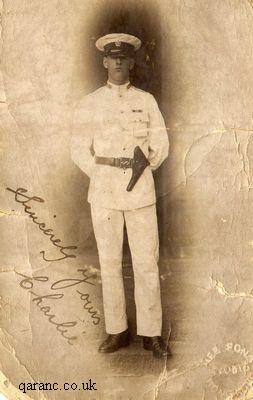
Below is a photograph of Charles Henry Goodwin Sub Inspector of Kong Police in his uniform. He was awarded a 2nd Class Hong Kong Police Merit medal. Charles Goodwin was interned at the Stanley Internment Camp. This was his last picture taken before being captured and then taken to the Prisoner of War camp in Hong Kong.
Just before his imprisonment he married a lady from Kowloon called Kwong Yuet. His wife, Kwong Yuet was sent to the Rosary Hill Red Cross Home. Many of his fellow Hong Kong policemen married at the same time in a mass wedding.
The photo below is of the grave of Charles Henry Goodwin Sub Inspector Kong Police. Sadly he died whilst a POW in June 1944 aged just 44 years.

Post War Years
After the Second World War BMH Bowen Road in Hong Kong became a families hospital with a children's ward and maternity unit. In addition to caring for British servicemen's families QAs nurses Chinese and Ghurkha patients.
In the mid 1950s there were riots in Hong Kong and fearing that they would spread to British Military Hospital Bowen Road the ward sisters were armed with pistols.
Alteration work to the original British Military Hospital Bowen Road building started in November 1952 and was completed by January 1953. This included ten new rooms for the QA staff and a new sitting room and modern conveniences. The building was inspected by Colonel E.M.E. Dawe, MBE, RRC and Major K.C. Harvey before each room was allocated to the first Other Ranks of the QARANC. The inspection By Col Dawe was reported in a newspaper article in the Hong Kong Standard newspaper on Sunday the 22 February 1953 which is pictured below. The caption read New Quarters For RANC Inspected.
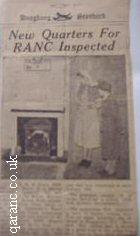
The QAs arrived aboard HMT Empire Fowey on the 24 February 53. Though 15 QA nurses were expected 5 were posted to Singapore.
General Keightley
The photo below was taken during an inspection at BMH Bowen Road Hong Kong children's ward in 1953 during a visit by General Keightley G.O.C. (General Officer Commanding). The General and his aides are wearing black armbands during the mourning period of the death of His Majesty King George.
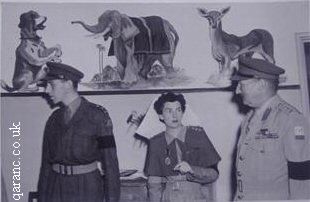
In the next photograph Gen Keightley can be seen chatting with the hospital chef, a Sergeant in the Army Catering Corps.

In the next picture the General is inspecting an adult ward at Bowen Road Hospital accompanied by the ward sister. If you can identify the accompanying QA officers in this collection of photographs then please contact Qaranc.co.uk.
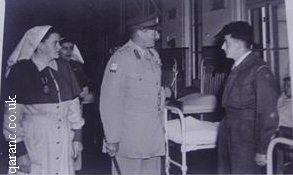
It is thought that the QA Officer above is Major Mount.
BMH Bowen Road became Island School in 1967.
The new BMH Hong Kong building was opened in June 1967 at King's Park in the New Territories (cited in the book Sub Cruce Candida: A Celebration of One Hundred Years of Army Nursing
).
These four photos of BMH Hong Kong and the two black and white photos of the exterior of British Military Hospital Hong Kong further above were kindly provided by Roger Nixon who served there from 1958 to 1960 where he met his future wife who was a serving QA. They recently celebrated their 50th wedding anniversary.
This photo shows the Gate House at BMH Hong Kong:
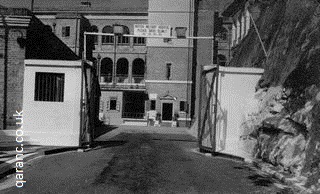
This image shows the QAs Billets at BMH Hong Kong:
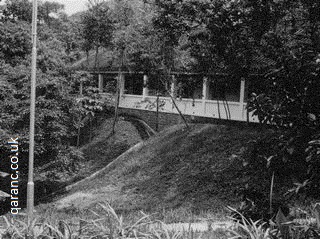
This photograph shows the front of BMH Hong Kong:
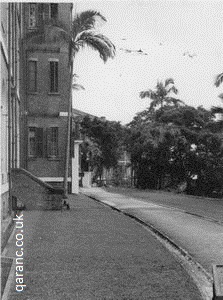
This picture shows the billet under the path lab at BMH Hong Kong:

The following photo of a group of nurses based at Bowen Road Hospital, Hong Kong around 1912c was found in a collection of photographs belonging to a male nurse of the RAMC who served in Hong Kong for around 11 years before being transferred to No 8 Field Hospital in Rouen at the outbreak of WW1. It is thought that they are not members of the Queen Alexandra's Imperial Military Nursing Service (QAIMNS). If you can help with any information please contact Qaranc.co.uk

If you would like to add any information to this page, share your memories or send me a picture or photograph of BMH Bowen Road Hong Kong then please contact me.
Qaranc.co.uk would like to thank Peter Truscott for the photograph of BMH Bowen Road, at the top of this page, which was taken in 1972 from the 8th floor of Viewpoint (No 7 Bowen Road).
The small building on the left of the BMH was used as the residence of Neil Harding, Deputy Headmaster, during the early years of it being a school.
Peter has also kindly provided links to more photographs of BMH Bowen Road.
Carmel School - Peter thinks the old BMH is still a school. This website shows the BMH (middle photo) clearly. www.carmel.edu.hk/
Another old pupil asking about the school. The reply he got is correct, the new Island School was build across the road and up the hillside. www.flickr.com
BMH is visible just off centre to the right in the bottom of this photo. The new Island School is the white complex to it's left. www.flickr.com
Hong Kong public archives with interesting photos: www.flickr.com
www.flickr.com
www.flickr.com

Free Book.
The death of the Brotherhood will be avenged.
RAF gunner Jason Harper and a team of Special Air Service operators are enraged after the death of their brothers by a terrorist drone strike. They fly into south-eastern Yemen on a Black-op mission to gather intelligence and avenge the death of their comrades.
Can they infiltrate the Al-Queda insurgents' camp, stay undetected, and call down their own drone missile strike and get home safely?
Will they all survive to fight another day?
Operation Wrath is a free, fast-paced adventure prequel to the non-stop action The Fence series by military veteran author C.G. Buswell.
Download for free on any device and read today.
This website is not affiliated or endorsed by The Queen Alexandra's Royal Army Nursing Corps (QARANC) or the Ministry of Defence.
» Contact
» Advertise
» QARANC Poppy Pin
» Poppy Lottery
» The Grey Lady Ghost of the Cambridge Military Hospital Novel - a Book by CG Buswell
» The Drummer Boy Novel
» Regimental Cap Badges Paintings
Read our posts on:
Offers
» Army Discounts
» Claim Uniform Washing Tax Rebate For Laundry
» Help For Heroes Discount Code
» Commemorative Cover BFPS 70th anniversary QARANC Association

Present Day
» Become An Army Nurse
» Junior Ranks
» Officer Ranks
» Abbreviations
» Nicknames
» Service Numbers
Ministry of Defence Hospital Units
» MDHU Derriford
» MDHU Frimley Park
» MDHU Northallerton
» MDHU Peterborough
» MDHU Portsmouth
» RCDM Birmingham
» Army Reserve QARANC
Photos
» Florence Nightingale Plaque
» Photographs
Uniform
» Why QA's Wear Grey
» Beret
» Army Medical Services Tartan
» First Time Nurses Wore Trousers AV Anti Vermin Battledress
» TRF Tactical Recognition Flash Badge
» Greatcoat TFNS
» Lapel Pin Badge

» Army School of Psychiatric Nursing Silver Badge
» Cap Badge
» Corps Belt
» ID Bracelet
» Silver War Badge WWI
» Officer's Cloak
» QAIMNSR Tippet
» QAIMNS and Reserve Uniform World War One
» Officer Medal
» Hospital Blues Uniform WW1
Events
» Armed Forces Day
» The Nurses General Dame Maud McCarthy Exhibition Oxford House London
» Edinburgh Fringe Stage Play I'll Tell You This for Nothing - My Mother the War Hero
» Match For Heroes
» Recreated WWI Ward
» Reunions
» Corps Day
» Freedom of Rushmoor
» Re-enactment Groups
» Military Events
» Remembrance
» AMS Carol Service
» QARANC Association Pilgrimage to Singapore and Malaysia 2009
» Doctors and Nurses at War
» War and Medicine Exhibition
» International Conference on Disaster and Military Medicine DiMiMED
» QA Uniform Exhibition Nothe Fort Weymouth
Famous QA's
» Dame Margot Turner
» Dame Maud McCarthy
» Lt Col Maureen Gara
» Military Medal Awards To QAs
» Moment of Truth TV Documentary
» Sean Beech
» Staff Nurse Ella Kate Cooke
Nursing
Nursing Jobs Vacancies UK
International Nurses Day
International Midwife Day
Info
» Search
» Site Map
» Contact
» Other Websites
» Walter Mitty Military Imposters
» The Abandoned Soldier
We are seeking help with some answers to questions sent by readers. These can be found on the Army Nursing page.
» Find QA's
» Jokes
» Merchandise
» Mugs
» Personalised Poster
» Poppy Badges
» Stamp
» Teddy Bears
» Pin Badges
» Wall Plaques
» Fridge Magnet