


» Site Map
» Home Page
Historical Info
» Find Friends - Search Old Service and Genealogy Records
» History
» QAIMNS for India
» QAIMNS First World War
» Territorial Force Nursing Service TFNS
» WW1 Soldiers Medical Records
» Field Ambulance No.4
» The Battle of Arras 1917
» The German Advance
» Warlencourt Casualty Clearing Station World War One
» NO 32 CCS Brandhoek - The Battle of Passchendaele
» Chain of Evacuation of Wounded Soldiers
» Allied Advance - Hundred Days Offensive
» Life After War
» Auxiliary Hospitals
» War Graves Nurses
» Book of Remembrance
» Example of Mentioned in Despatches Letter
» Love Stories
» Autograph Book World War One
» World War 1 Letters
» Service Scrapbooks
» QA World War Two
» Africa Second World War
» War Diaries of Sisters
» D Day Normandy Landings
» Belsen Concentration Camp
» Italian Sailor POW Camps India World War Two
» VE Day
» Voluntary Aid Detachment
» National Service
» Korean War
» Gulf War
» Op Telic
» Op Gritrock
» Royal Red Cross Decoration
» Colonels In Chief
» Chief Nursing Officer Army
» Director Army Nursing Services (DANS)
» Colonel Commandant
» Matrons In Chief (QAIMNS)
Follow us on Twitter:

» Grey and Scarlet Corps March
» Order of Precedence
» Motto
» QA Memorial National Arboretum
» NMA Heroes Square Paving Stone
» NMA Nursing Memorial
» Memorial Window
» Stained Glass Window
» Army Medical Services Monument
» Recruitment Posters
» QA Association
» Standard
» QA and AMS Prayer and Hymn
» Books
» Museums
Former Army Hospitals
UK
» Army Chest Unit
» Cowglen Glasgow
» CMH Aldershot
» Colchester
» Craiglockhart
» DKMH Catterick
» Duke of Connaught Unit Northern Ireland
» Endell Street
» First Eastern General Hospital Trinity College Cambridge
» Ghosts
» Hospital Ghosts
» Haslar
» King George Military Hospital Stamford Street London
» QA Centre
» QAMH Millbank
» QEMH Woolwich
» Medical Reception Station Brunei and MRS Kuching Borneo Malaysia
» Military Maternity Hospital Woolwich
» Musgrave Park Belfast
» Netley
» Royal Chelsea Hospital
» Royal Herbert
» Royal Brighton Pavilion Indian Hospital
» School of Physiotherapy
» Station Hospital Ranikhet
» Station Hospital Suez
» Tidworth
» Ghost Hunt at Tidworth Garrison Barracks
» Wheatley
France
» Ambulance Trains
» Hospital Barges
» Ambulance Flotilla
» Hospital Ships
Germany
» Berlin
» Hamburg
» Hannover
» Hostert
» Iserlohn
» Munster
» Rinteln
» Wuppertal
Cyprus
» TPMH RAF Akrotiri
» Dhekelia
» Nicosia
Egypt
» Alexandria
China
» Shanghai
Hong Kong
» Bowen Road
» Mount Kellett
» Wylie Road Kings Park
Malaya
» Kamunting
» Kinrara
» Kluang
» Penang
» Singapore
» Tanglin
» Terendak
Overseas Old British Military Hospitals
» Belize
» Falklands
» Gibraltar
» Kaduna
» Klagenfurt
» BMH Malta
» Nairobi
» Nepal
Middle East
» Benghazi
» Tripoli
Field Hospitals
» Camp Bastion Field Hospital and Medical Treatment Facility MTF Helmand Territory Southern Afghanistan
» TA Field Hospitals and Field Ambulances
Dame Margot Turner
Information about the life and career of Dame Margot Turner an Army Nursing Sister who was a WWII Prisoner of War of the Japanese who then became Matron In Chief of the QARANC:
Surviving Tenko: The Story of Margot Turner
 and
Will to Live: Story of Dame Margot Turner
and
Will to Live: Story of Dame Margot Turner tells the remarkable story of Margot Turner, a sister in the British Army's nursing corps (The Queen Alexandra's Imperial Military Nursing Service) who served in
Malaya during the Second World War.
tells the remarkable story of Margot Turner, a sister in the British Army's nursing corps (The Queen Alexandra's Imperial Military Nursing Service) who served in
Malaya during the Second World War.
Dame Margot Turner was evacuated, with the rest of the hospital in which she served, to Singapore, ahead of the Japanese invasion in 1942. Unfortunately the ship she was evacuated in was sunk but she survived on a raft with another nursing sister. Between them they rescued six children and eight women.
They had no food or water and all died but Margot Turner.
She was rescued from the Ocean by a Japanese Destroyer only to be imprisoned as a Prisoner of War (POW). The Will To Live tells the story of how Margot Turner and her fellow prisoners survived under this brutal regime and prison camp privations for three and half years.
Margot Turner survived and continued her British Army Nursing Career and eventually rose to become the Director Army Nursing Service from 1964 to 1968 and the Colonel Commandant of the Queen Alexandra's Royal Army Nursing Corps in 1969.
The collection of photographs in the book Sisters In Arms: British Army Nurses Tell Their Story
 has a photo of Dame Margot Turner taken during a survivors reunion.
It also contains recorded recollections by Dame Margot Turner from the QARANC Collection held at the AMS Museum.
has a photo of Dame Margot Turner taken during a survivors reunion.
It also contains recorded recollections by Dame Margot Turner from the QARANC Collection held at the AMS Museum.
She was made a Dame and was awarded the Royal Red Cross Medal and was made an Officer of the British Empire (OBE).
Below is the plaque dedicated to her memory in the Aldershot Garrison church.
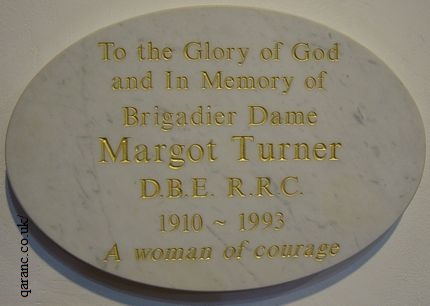
Photo Credit: Terry Hissey.
It reads:
To the glory of God
and in memory of
Brigadier Dame
Margot Turner
DBE RRC
1910 – 1993
A woman of courage
More plaques dedicated to army nurses can be seen on the lower section of the war graves and memorials page.
Follow us on Facebook, Instagram and Twitter.

My PTSD assistance dog, Lynne, and I have written a book about how she helps me with my military Post Traumatic Stress Disorder, anxiety, and depression. I talk about my time in the QAs and the coping strategies I now use to be in my best health.
Along the way, I have had help from various military charities, such as Help for Heroes and The Not Forgotten Association and royalties from this book will go to them and other charities like Bravehound, who paired me with my four-legged best friend.
I talk openly about the death of my son by suicide and the help I got from psychotherapy and counselling and grief charities like The Compassionate Friends.
The author, Damien Lewis, said of Lynne:
"A powerful account of what one dog means to one man on his road to recovery. Both heart-warming and life-affirming. Bravo Chris and Lynne. Bravo Bravehound."
Download.
Buy the Paperback.
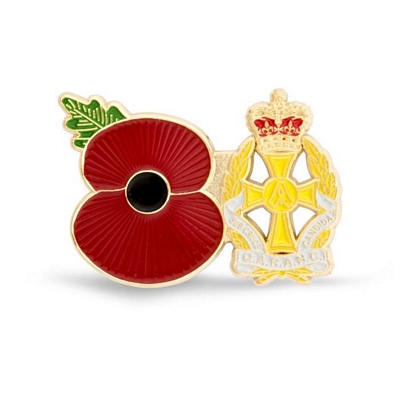
This beautiful QARANC Poppy Pin Badge is available from the Royal British Legion Poppy Shop.
For those searching military records, for information on a former nurse of the QAIMNS, QARANC, Royal Red Cross, VAD and other nursing organisations or other military Corps and Regiments, please try Genes Reunited where you can search for ancestors from military records, census, birth, marriages and death certificates as well as over 673 million family trees. At GenesReunited it is free to build your family tree online and is one of the quickest and easiest ways to discover your family history and accessing army service records.
More Information.
Another genealogy website which gives you access to military records and allows you to build a family tree is Find My Past which has a free trial.
Sir John Smyth
Will to Live: The Story of Dame Margot Turner was published in 1970 by the publishers Cassell. This biography was written by Sir John Smyth who is a holder of the Victoria Cross for his valour in World War I. Sir John Smyth also fought in World War II where he was awarded the Military Cross. He founded the Victoria Cross Association and has written many army and military books. View his other books
 .
He was also called Jackie Smyth.
.
He was also called Jackie Smyth.
Dame Margot Turner - Will To Live is now out of print but can be purchased from the online book shop Amazon. Click here to buy
 or for more information.
It was reviewed by Soldier Magazine in October 1970:

Biography of Margot Turner
Margot Turner underwent her nurse training at St Bartholomew's Hospital in London, England, UK. She was a keen sportswoman and enjoyed playing a variety of sports such as tennis, golf, swimming and hockey. She would ride the Life Guards horses at nearby Knightsbridge.
Between 1939 and 1941 Margot Turner was a theatre nurse sister of The Queen Alexandra's Imperial Military Nursing Service (QAIMNS) and nursed at the British Garrison Military Hospital in Meerut, India.
Surviving Tenko: The Story of Margot Turner
describes her pre-World War Two career with postings to
CMH Aldershot, QAMH Millbank and Bareilly and Ranikhet Hospitals
in India.
However she wanted to become more involved in the war effort and requested a posting to Europe. She was refused many times because the surgeons in India wanted to keep their hard working theatre sister. Margot Turner persevered and eventually got a posting to a transit camp in Bombay which should then have given her an opportunity to be posted to Europe. Instead she was posted, on 1 March 1941, to Number 17 Combined General Hospital in Kuala Lumpur, Malaysia to take charge of the operating theatre.
Surviving Tenko: The Story of Margot Turner
details her voyage, along with the other members of No 17 Combined General Hospital, aboard ship to an unknown location several days later. The captain of the ship was instructed to open his top secret orders at midnight of the 8 March and announced that they were bound for Singapore,
where they would set up their hospital at Tanjong Malim.
At the time this was far from the dangers of war and servicemen and women enjoyed a peaceful life until the Japanese bombed Pearl Harbour on the 7 December 1941 and invaded the Pacific turning their attacks to the Malay Peninsula as well as Hong Kong and Luzon. On the night of the 8 December 1941 Kuala Lumpur was bombed. The decision was taken to move the hospital, patients and staff, including Margot Turner, on Christmas Eve. They were evacuated to the Alexandra Hospital (BMH Singapore). Doctors and nurses worked around the clock caring for wounded and injured as they defended Singapore against the invading Japanese troops. Several days later Sister Margot Turner was moved to Changi where her duties were mainly to help move patients to Singapore city.
General Percival at Malayan Command Headquarters heard of the atrocities that befell the nurses at Hong Kong which included being repeatedly raped by the Japan Army and killings of nursing staff and ordered the immediate evacuation of the Allied troops Singapore female nurses of the QAIMNS and the Australian Army Nursing Corps (AANS).
Surviving Tenko: The Story of Margot Turner
cites that matrons of the military hospitals asked for nurses to volunteer to leave and none did because of their devotion to their patients. So matrons had to choose who left, or pull names from hats. The first nurses left Singapore Island on the 11 February 1941, bound for Batavia, on-board the Empire Star.
On the 12 February Sister Turner narrowly escaped being hit by an exploding shell when the Japanese army bombed the officer’s mess. She was then evacuated with 50 other nursing sisters and four matrons.
Nurses met at the Singapore Cricket Club on the 13 February 1942 where they were to be evacuated to the ship Kuala along with other women, children nurses, four matrons and some servicemen. Unfortunately some of the waiting nursing sisters were killed during an air raid as they tried to board the ship. The ship eventually sailed off but further danger awaited when the ship was bombed killing all four matrons. The crew and passengers abandoned ship and took to the sea with only two life boats and few life belts. Many drowned and more were machine gunned or bombed by the merciless Japanese planes. Margot Turner and some others eventually made it to the Island of Pom Pong.
Other nurses on other ships were not so fortunate such as those onboard the ship Vyner Brooke who were also shipwrecked after bombing. They were able to remain in the water thanks to life jackets and were afloat for about 16 hours before being able to get ashore on Banka Island. In his book Heroines of World War II
 Eric Taylor describes their cold blooded killings of some nurses at the hands of troops from Japan.
Unfortunately they were found by twenty Japanese soldiers
who ordered them back into the water. They were then all shot dead with the exception of Sister Vivien Bullwinkel who survived by feigning death despite being painfully
wounded. After the war she was able to identify the officers who gave this unjust order and they were found guilty at a war tribunal.
Eric Taylor describes their cold blooded killings of some nurses at the hands of troops from Japan.
Unfortunately they were found by twenty Japanese soldiers
who ordered them back into the water. They were then all shot dead with the exception of Sister Vivien Bullwinkel who survived by feigning death despite being painfully
wounded. After the war she was able to identify the officers who gave this unjust order and they were found guilty at a war tribunal.
Brenda McBryde in Quiet Heroines: Nurses of the Second World War
 describes how they and their Matron, Miss Drummond, were witnesses to a Japanese atrocity were soldiers ordered all their male prisoners including the wounded over the brow of a dune where they were bayoneted to death. They then ordered the women into the sea where they were machine gunned to prevent any of them becoming a witness to their earlier barbaric attack.
Other ships were bombed and destroyed by the Japanese and some survivors were rescued by the ship Tanjong Penang. The Captain asked some of the nurses who had made it ashore to board his ship to care for the wounded and injured. This was a hard decision for the nurses to make because the Japanese Air Force and Navy were still attacking the ships but Margot Turner and some of her colleagues volunteered and boarded the Tanjong Penang on 17 February and worked non stop tended to their new patients.
Later that night of the 18 February 1942 they were attacked by a Japanese Navy warship. During the shelling some of the nurses were injured such as Sister Beatrice le Blanc, many of their patients died during the attack. The ship went onto her side and suddenly sank taking with her many that were in her hold. Some, like Margot Turner and Sister le Blanc managed to jump into the sea and made their way to two lift rafts that a crew member had managed to get off the ship before she sank. Together they tied the lift rafts to each other and set about rescuing the living that were floating amongst the dead.
The Imperial War Museum Oral History Interview with Dame Margot Turner where she recalls this dreadful time can be read in Surviving Tenko: The Story of Margot Turner
.
The two nurses bravely rescued fourteen women and children but there was not room on the rafts for all of the them so they stayed in the water hanging on to the rope handles and organised a rota for the less wounded to take turns in the water whilst others rested in a life raft whilst holding a child or having one sat on their knees.
Sister Beatrice le Blanc stayed in the water despite a large buttock wound and loosing a great del of blood. By dawn she appeared ashen and Margot Turner heaved her onto a life raft only to discover her friend was dying. She died later in the afternoon. Margot had no option but to say a prayer for her and the other dead before sliding them gently to the Java sea. The survivors were now able to stay in the life rafts with just a few clinging to the ropes.
Sadly other survivors soon died in the hot sun from dehydration, from their injuries and their wounds. This included all the children. By the night of the 19 February 1942 only Margot Turner and one other woman, Mrs Barnett, were left alive. They spotted some driftwood and managed to get two pieces that could be used as makeshift oars and slowly paddled their way to a nearby island. This was painful work and their bodies were full of painful open sores, blisters and patches of raw skin. Mrs Barnett's makeshift oar slipped and as she reached out to grab it she fell into the water but did manage to grab a life jacket. She shouted to Margot not to leave the life raft to rescue her and she was swept away.
Margot Turner was now alone and to conserve her energy she lay down and prayed. It later rained and she was able to drink some rain water caught in her mouth and some she caught in a compact mirror she had in her pocket. She became rain soaked and sucked her grey dress for extra non salty water. She later found some seaweed drifting past and ate this.
Four days later she saw a passing warship and feebly waved. Unfortunately it was a Japanese ship. They threw down a rope but she was too exhausted to climb it so a sailor climbed down and tied the rope to her emaciated body and the crew pulled her up. Fortunately the warship had a Japanese doctor who spoke English and had been trained in an American hospital. He nursed her back to health by leaving her in the shade and feeding her a weak solution of tea with a little whisky before building up to a milky drink. His nurses tended to her wounds and took off her grey salt soaked uniform that was chaffing her skin and dressed her in a clean shirt and trousers.
Learning that she was a nursing sister the doctor tried his best to see to Margot Turner's welfare, even carrying her off on a stretcher himself with the help of a sailor when they docked at Muntok port. He was ordered to take her to the civilian prisoner of war camp where he saluted her and had to leave. His ship did not leave for four days and he visited Margot each day and on the fourth day gave her a wrapped present - her grey dress neatly folded and freshly laundered. This was the last day she saw him.
Her strength soon returned and this helped her survive a terrible ordeal in this Japanese prison along with other nurses such as Sister Vivien Bullwinkel who survived the shooting massacre and had been captured making her escape through the jungle.
Life in the prison camp was harsh for the QAs and fellow prisoners. They had to sleep on concrete floors and take turns sleeping on the few straw mattresses. There was little chance to sleep because the brutal guards would rap their feet with their torches or hit their legs as they passed. Food was minimal and mostly consisted of a few helpings of watery rice and a few pieces of octopus tentacles with only one mug of water a day to drink. Diseases and illnesses were rife and many POWs died. Margot suffered from poisoning from her boils from the sea water which spread to her lymph glands and these had to be lanced by a blunt scalpel in unsterile conditions by one of the POW doctors.
On 1 April 1942 Margot Turner was well enough to be moved, though by stretcher, to Palembang in Sumatra where she was cared for by Dutch nuns of the Roman Catholic Charitas Order. Once healthy she took part in camp life such as gathering fuel for cooking and carrying bags of rice and caring for the sick. During inspections by the guards, which were called Tenko, she and other Prisoners of War had to stand for hours in the sun until the guards had considered their counting finished. Many would collapse in the heat from exhaustion and get beaten by the guards. Margot had her front tooth and lip burst open when a Japanese officer considered her disrespectful for not bowing low enough.
In October 1942 Margot Turner and three other nurses were volunteered by the Japanese to work in a local hospital which was run by Dutch and Indonesian doctors. This included the Dutch Dr Hollweg the former Red Cross representative in Palembang and his wife. Margot was placed as the theatre nurse working with a Dutch surgeon and quickly learnt to speak the Malay language.
The other nurses were fellow QA Mary Cooper and Colonial Sisters Jenny McAllister and Mrs Olga Neubrunner (cited in Quiet Heroines: Nurses of the Second World War
by Brenda McBryde).
All went well for many months and this gave the four nurses the chance to eat better and even shop at the local market for the patients.
In March 1943 the Dutch doctor who was head of the hospital was throw into jail by the Kempei Tai (Japanese Military Police) for no reason and a Japanese doctor was placed in charge of the hospital. Disciple became really tight and on the 6 April all four nurses were arrested and placed in the local prison alongside murderers and thieves for no obvious reason. All items were removed from their personal possession including their white muslin nursing dresses and they had to wear a white sarong. They were placed in separate small cells with little food or drink and had to watch other prisoners being tortured and executed. Two Dutch doctors died from beatings.
Months later the nurses were placed together in a larger cell and this allowed them to care for each other. One nurse called Jennie seemed to be suffering from Typhoid fever but was nursed back to health. They stayed together until the 22 September 1943 when they were taken to an internment camp for women and one of the nurses died in the camp hospital a few days later.
Dame Margot Turner rarely spoke of this time in Palembang jail. An extract from Surviving Tenko: The Story of Margot Turner
quotes her:
The other prisoners were a rum lot, I don’t know what they had done but they were good to me. They shared their food if they had and any they were considerate. There were so many unspeakable things going on. It is not something that I really talk about much – the things they were doing to local people. You could hear the screams. There are some things that were unspeakable – even in the books that are written about it. I don’t say anything about it. It is just something I don’t say.
The three surviving nurses and the women of the camp were transferred to Palembang but some died on the boat and train journeys because they were packed so tight in carriages with no ventilation and locked doors and windows in intense heat. At the new camp food rations were even scarcer and many died from malnutrition and the vermin ridden conditions. Dysentery, Banka fever (cerebral malaria) and beriberi claimed more lives as did the Tenko parades and savage beatings and punishments.
Margot Turner somehow survived until on the 20 August 1945 the prison guards started to look after their charges, even giving them fourteen pigs to cook and eat. The women ate each part of the pig to build their strength up, not knowing what was going on. They did not know that the Germans had surrendered to the Allies and that the Japanese would soon surrender because Hiroshima and Nagasaki had been bombed with the newly invented atomic bombs and their troops were being driven back by an advancing Allied force. Nor did they know that officers were commanded to destroy any evidence of ill treatment of prisoners, including starving figures. All the women were wafer thin with protruding bones and bloated stomachs from rice diets. Many Japanese troops and officers either fled the prison camps or killed themselves by their own swords by hara-kiri.
Allied troops searched out for prison camps and freed the POWs and interned civilians, arresting any guards still alive. In September 1945 an American airplane had spotted the camp in which Margot Turner and her fellow nurses, like Netta her close friend throughout this ordeal, were still surviving and dropped off food parcels until Allied land troops or could reach them and clear areas for airplanes to land. These life saving parcels contained fresh bread and much needed medical supplies.
On the 17 September an Australian aircraft airlifted Margot Turner and the other camp occupants and took then to safety. Margot Turner was eventually taken to Singapore where she and Netta were accommodated at Raffles Hotel (cited as 19th September in Surviving Tenko: The Story of Margot Turner
) after three years and seven months of cruelty and imprisonment by the Japanese. She and her fellow former captives received medical and dental care at Alexandra
Hospital, the BMH Singapore. By coincidence the sister who treated her was one that she had trained with at
St Bartholomew's Hospital in London. Her friend did not at first recognise her because she looked so thin, emaciated and had two of her front teeth missing.
After treatment Margot Turner sailed for England on the 26 September 1945. The sea voyage on the Polish ship Sobieski took a month during which time she rested and recuperated more before spending six weeks of leave with her mother at Hove. Margot Turner returned to serving with the QAIMNS and then the QARANC when it reformed to the Queen Alexandra's Royal Army Nursing Corps.
Buy Surviving Tenko: The Story of Margot Turner
Buy Will to Live: Story of Dame Margot Turner
Her first military hospital posting was to The Queen Alexandra's Military Hospital Millbank, London.
In February 1946 Margot Turner was awarded the Member of the Order of the British Empire (MBE) and the Pacific Star for her wartime service.
Surviving Tenko: The Story of Margot Turner
describes her army nursing career after World War Two. In particular her work with surgeon Colonel Marsden (RAMC) who helped her quickly regain her confidence and learn new practices in theatre nursing.
Margot Turner went on to have a distinguished career with the QAs in many UK and overseas military hospitals,s such as BMH Malta in May 1947 and BMH Nicosia in December 1948, rising through the ranks to become Brigadier, the highest rank for a QA.
In 1953 Captain Margot Turner led the QAs during the Queen’s Coronation Parade and was awarded the Coronation medal. More is written about this historic event on the History of Army Nursing and the QA's page.
Captain Margot Turner was awarded the Royal Red Cross Medal and was presented it by Her Majesty Queen Elizabeth II at Buckingham Palace in 1957. She was promoted to Major the same year and to Colonel by 1962 (cited in Surviving Tenko: The Story of Margot Turner
).
In 1964 Brigadier Margot Turner became the Director Army Nursing Service and Matron-in-Chief (Army) for the QARANC until 1968.
In June 1965 Brigadier Margot Turner was awarded the title of Dame Commander of the Order of the British Empire (DBE). Her military rank and title became Brigadier Dame Margot Turner.
Brigadier Dame Margot Turner was honoured with the position of QHNS (Queen's Honorary Nursing Sister).
In 1965 Brigadier Margot Turner was awarded with a plaque in recognition of her distinguished service to military nursing by the Chief of the United States Army Nursing Corps in Washington.
In October 1967 the QA Training Centre in Aldershot was officially opened and Brigadier Dame Margot Turner escorted the Colonel in Chief, Princess Margaret, who officially opened the centre.
After retiring in 1968 Brigadier Dame Margot Turner was appointed to the position of Colonel Commandant of the Queen Alexandra's Royal Army Nursing Corps in 1969 and served until 1974.
This Is Your Life
Dame Margot Turner was the subject of This Is Your Life television programme on 25 January 1978 and was awarded the famous red book by Eamonn Andrews. She was reunited with many of her friends and colleagues in her long career including former POWs who sung their Captives Hymn. The researcher, Lavinia Warner, was so moved by her story that she devised the classic BBC series Tenko
 , with producer John Sandilands. Tenko ran for three series and a one off episode reunion.
Another BBC TV programme to feature Dame Margot Turner was the documentary Omnibus with Ludovic Kennedy where she retraced her WWII footsteps and revisited Muntok, Palembang Jail, Palembang cemetery and Charitas Hospital to search for the Prisoner Of War camps she was held in. She was accompanied by another former Japanese POW, Mrs Betty Jeffrey.
Dame Margot Turner died in Brighton on 24 September 1993.
Read her Obituary from The Guardian and details of the Service of Thanksgiving as reported in The Daily Telegraph.
More QARANC Book Reviews.

Former Royal Air Force Regiment Gunner Jason Harper witnesses a foreign jet fly over his Aberdeenshire home. It is spilling a strange yellow smoke. Minutes later, his wife, Pippa, telephones him, shouting that she needs him. They then get cut off. He sets straight out, unprepared for the nightmare that unfolds during his journey. Everyone seems to want to kill him.
Along the way, he pairs up with fellow survivor Imogen. But she enjoys killing the living dead far too much. Will she kill Jason in her blood thirst? Or will she hinder his journey through this zombie filled dystopian landscape to find his pregnant wife?
The Fence is the first in this series of post-apocalyptic military survival thrillers from the torturous mind of former British army nurse, now horror and science fiction novel writer, C.G. Buswell.
Download Now.
Buy the Paperback.
If you would like to contribute to this page, suggest changes or inclusions to this website or would like to send me a photograph then please e-mail me.

Free Book.
The death of the Brotherhood will be avenged.
RAF gunner Jason Harper and a team of Special Air Service operators are enraged after the death of their brothers by a terrorist drone strike. They fly into south-eastern Yemen on a Black-op mission to gather intelligence and avenge the death of their comrades.
Can they infiltrate the Al-Queda insurgents' camp, stay undetected, and call down their own drone missile strike and get home safely?
Will they all survive to fight another day?
Operation Wrath is a free, fast-paced adventure prequel to the non-stop action The Fence series by military veteran author C.G. Buswell.
Download for free on any device and read today.
This website is not affiliated or endorsed by The Queen Alexandra's Royal Army Nursing Corps (QARANC) or the Ministry of Defence.
» Contact
» Advertise
» QARANC Poppy Pin
» Poppy Lottery
» The Grey Lady Ghost of the Cambridge Military Hospital Novel - a Book by CG Buswell
» The Drummer Boy Novel
» Regimental Cap Badges Paintings
Read our posts on:
Offers
» Army Discounts
» Claim Uniform Washing Tax Rebate For Laundry
» Help For Heroes Discount Code
» Commemorative Cover BFPS 70th anniversary QARANC Association

Present Day
» Become An Army Nurse
» Junior Ranks
» Officer Ranks
» Abbreviations
» Nicknames
» Service Numbers
Ministry of Defence Hospital Units
» MDHU Derriford
» MDHU Frimley Park
» MDHU Northallerton
» MDHU Peterborough
» MDHU Portsmouth
» RCDM Birmingham
» Army Reserve QARANC
Photos
» Florence Nightingale Plaque
» Photographs
Uniform
» Why QA's Wear Grey
» Beret
» Army Medical Services Tartan
» First Time Nurses Wore Trousers AV Anti Vermin Battledress
» TRF Tactical Recognition Flash Badge
» Greatcoat TFNS
» Lapel Pin Badge

» Army School of Psychiatric Nursing Silver Badge
» Cap Badge
» Corps Belt
» ID Bracelet
» Silver War Badge WWI
» Officer's Cloak
» QAIMNSR Tippet
» QAIMNS and Reserve Uniform World War One
» Officer Medal
» Hospital Blues Uniform WW1
Events
» Armed Forces Day
» The Nurses General Dame Maud McCarthy Exhibition Oxford House London
» Edinburgh Fringe Stage Play I'll Tell You This for Nothing - My Mother the War Hero
» Match For Heroes
» Recreated WWI Ward
» Reunions
» Corps Day
» Freedom of Rushmoor
» Re-enactment Groups
» Military Events
» Remembrance
» AMS Carol Service
» QARANC Association Pilgrimage to Singapore and Malaysia 2009
» Doctors and Nurses at War
» War and Medicine Exhibition
» International Conference on Disaster and Military Medicine DiMiMED
» QA Uniform Exhibition Nothe Fort Weymouth
Famous QA's
» Dame Margot Turner
» Dame Maud McCarthy
» Lt Col Maureen Gara
» Military Medal Awards To QAs
» Moment of Truth TV Documentary
» Sean Beech
» Staff Nurse Ella Kate Cooke
Nursing
Nursing Jobs Vacancies UK
International Nurses Day
International Midwife Day
Info
» Search
» Site Map
» Contact
» Other Websites
» Walter Mitty Military Imposters
» The Abandoned Soldier
We are seeking help with some answers to questions sent by readers. These can be found on the Army Nursing page.
» Find QA's
» Jokes
» Merchandise
» Mugs
» Personalised Poster
» Poppy Badges
» Stamp
» Teddy Bears
» Pin Badges
» Wall Plaques
» Fridge Magnet