


» Site Map
» Home Page
Historical Info
» Find Friends - Search Old Service and Genealogy Records
» History
» QAIMNS for India
» QAIMNS First World War
» Territorial Force Nursing Service TFNS
» WW1 Soldiers Medical Records
» Field Ambulance No.4
» The Battle of Arras 1917
» The German Advance
» Warlencourt Casualty Clearing Station World War One
» NO 32 CCS Brandhoek - The Battle of Passchendaele
» Chain of Evacuation of Wounded Soldiers
» Allied Advance - Hundred Days Offensive
» Life After War
» Auxiliary Hospitals
» War Graves Nurses
» Book of Remembrance
» Example of Mentioned in Despatches Letter
» Love Stories
» Autograph Book World War One
» World War 1 Letters
» Service Scrapbooks
» QA World War Two
» Africa Second World War
» War Diaries of Sisters
» D Day Normandy Landings
» Belsen Concentration Camp
» Italian Sailor POW Camps India World War Two
» VE Day
» Voluntary Aid Detachment
» National Service
» Korean War
» Gulf War
» Op Telic
» Op Gritrock
» Royal Red Cross Decoration
» Colonels In Chief
» Chief Nursing Officer Army
» Director Army Nursing Services (DANS)
» Colonel Commandant
» Matrons In Chief (QAIMNS)
Follow us on Twitter:

» Grey and Scarlet Corps March
» Order of Precedence
» Motto
» QA Memorial National Arboretum
» NMA Heroes Square Paving Stone
» NMA Nursing Memorial
» Memorial Window
» Stained Glass Window
» Army Medical Services Monument
» Recruitment Posters
» QA Association
» Standard
» QA and AMS Prayer and Hymn
» Books
» Museums
Former Army Hospitals
UK
» Army Chest Unit
» Cowglen Glasgow
» CMH Aldershot
» Colchester
» Craiglockhart
» DKMH Catterick
» Duke of Connaught Unit Northern Ireland
» Endell Street
» First Eastern General Hospital Trinity College Cambridge
» Ghosts
» Hospital Ghosts
» Haslar
» King George Military Hospital Stamford Street London
» QA Centre
» QAMH Millbank
» QEMH Woolwich
» Medical Reception Station Brunei and MRS Kuching Borneo Malaysia
» Military Maternity Hospital Woolwich
» Musgrave Park Belfast
» Netley
» Royal Chelsea Hospital
» Royal Herbert
» Royal Brighton Pavilion Indian Hospital
» School of Physiotherapy
» Station Hospital Ranikhet
» Station Hospital Suez
» Tidworth
» Ghost Hunt at Tidworth Garrison Barracks
» Wheatley
France
» Ambulance Trains
» Hospital Barges
» Ambulance Flotilla
» Hospital Ships
Germany
» Berlin
» Hamburg
» Hannover
» Hostert
» Iserlohn
» Munster
» Rinteln
» Wuppertal
Cyprus
» TPMH RAF Akrotiri
» Dhekelia
» Nicosia
Egypt
» Alexandria
China
» Shanghai
Hong Kong
» Bowen Road
» Mount Kellett
» Wylie Road Kings Park
Malaya
» Kamunting
» Kinrara
» Kluang
» Penang
» Singapore
» Tanglin
» Terendak
Overseas Old British Military Hospitals
» Belize
» Falklands
» Gibraltar
» Kaduna
» Klagenfurt
» BMH Malta
» Nairobi
» Nepal
Middle East
» Benghazi
» Tripoli
Field Hospitals
» Camp Bastion Field Hospital and Medical Treatment Facility MTF Helmand Territory Southern Afghanistan
» TA Field Hospitals and Field Ambulances
War Diaries
Collection of War Diaries of Army Nursing Sisters of the Queen Alexandra's Imperial Military Nursing Service from World War 2
Below are extracts from the war diaries of Nursing Sister Margaret Eva Price. She was born 24 February 1894 and left Barts as a qualified SRN in November 1920. She then returned to Barts for a six week duty as a Sister 2 in 1923. Much of her training period involved nursing WW1 soldiers in the surgical wards, which her family think may explain her interest in army nursing. In her student records she is described as having done six months work as a nursing auxiliary in a military hospital prior to entering Barts as a probationer.
World War 2 Diary
Below is her World War 2 diary describing her experiences with the QAs at various CCSs in Europe as part of the WW2 British Liberation Army. She was called up at age 50 as a QA reservist. These war diary extracts have been kindly provided by her family, who knew her as Aunt Madge, taken from four closely-typed pages of foolscap flimsy and is an account of her days with the BLA from landing in Normandy all through the trek to the German border. It makes fascinating reading. In those notes she refers to previous QA service in India.
After the war Sister Price became Matron of a Sussex nursing home and entertained Princess Alexandra when she came to open a new wing. She wore her QA medallion. Sister Price died in 1983.
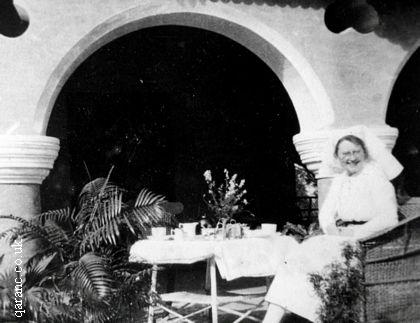
It has always been the tradition of the Q.A.I.M.N.S. to serve wherever they are needed. In peacetime this may mean anywhere in the British Empire, in wartime in all theatres of war in places as far apart as Iceland or Singapore, Scotland or Mesopotamia, and in the present stage of the war, on the Continent or in Burma. We are now at what we know is the final phase of the war, and since June of last year, a very large proportion of the Service is with the British Liberation Army – having followed the troops across the Channel, camped in Normandy orchards and trekked across North France and Flanders into the countryside of Belgium and the villages of Holland near to the Western borders of Germany.
In order to be of use to the Army, it is as well to know how they live, just as those who have experienced illness can tell far better than those who have never been ill, what it feels like. We are all apt to be slightly un-imaginative about something which troubles us personally not at all, but when we have lived it for ourselves, it means something and that knowledge can be translated into practical efficiency.
Like the men, our units mobilised in U.K. and when the time came, proceeded to a marshalling area, ready for embarkation. This meant living in a transit camp until we left England. These camps are remarkably well run and we lived in great comfort. The food was excellent, there were hot and cold showers, and even organised entertainment in the form of a cinema. The only drawback was that we now had to break off communication with the outside world, owing to security being such a vital matter. We felt rather like disembodied spirits, as though still at home, no news could be given to one’s family.
However, the period was a busy enough time for most units as there was less than 24 hours to wait and our minds were on personal equipment and how to compress all necessities into the most portable form. Throughout the hours in camp, a business-like voice could be heard issuing instructions over a loudspeaker to those who were due to depart. Our turn came at the reasonable hour of 6.30a.m. Breakfast was at 7 a.m. and departure was timed for 8 a.m. for the nearest port. Here again, all was rapid and well-organised – no more than time for a cup of tea before we went up the gangway onto a Hospital Carrier. We were the first members of the Service to be transported on that particular Carrier and the staff on board were somewhat tickled to see their colleagues laden like pack-horses struggling up the gangway. Tin helmets, water bottles, gas masks, haversacks, were all carried slung like those of the men.
The crossing was quiet and uneventful and again we had every facility for washing, much appreciated as we always expected each time to be the last. We slept in our clothes that night, anchored off the French coast, and although there was a certain amount of air activity overhead it was easy enough to pass right out in the rather drugged atmosphere of a rigid black-out.
We were ashore next morning by 9 a.m. and it was a good feeling to know that we were following up those who had stormed the beaches on D-Day. Everyone left behind in England after June 6th knows how empty the country seemed when all the troops had left. How quiet London appeared, how different the journey in a train where one could get a compartment to oneself instead of standing in a corridor lined with the British Army. Well, it was our turn to be among them now "over there" and our privilege to live under the same conditions. We came to it feeling lucky to be in it and although there are times when this feeling wears thin, because it is no longer a novelty, I doubt if anyone would want to be without the experience.
The next few weeks must be sketched quickly because we were not working. General impressions stand out, the dusty ride from the beach over bad roads to our destination in Normandy. The welcome given us by the men who caught sight of us passing, and seemed glad to know we were with them. Journey’s end for that day was another transit camp attached to a large hospital, and there we stayed for ten days, adapting ourselves to being under canvas.
When the weather was good it seemed like a summer holiday in rather peculiar surroundings. When bad, we tried to adjust ourselves, rather painfully, to walking across two sodden, muddy fields to breakfast wearing the invaluable army boots, tin hats and gas capes for protection.
Off again after ten days to stake out a claim on our own field with our own board outside showing that we counted at last among the "also rans" in Harley Street – so called because the road was lined with the Medical profession.
This field seemed particularly wet and the tents had a nauseating habit of falling down when the gales started. We often felt we were qualified for the rum ration at that time, especially the night when the Post Office collapsed and our sodden letters were brought back the next day to be re-written. However, we developed some sort of routine and in between the business of lighting the Soya stoves to get ourselves and our clothes clean, we found time to lorry-hop into the nearest town for the odd spot of entertainment at the E.N.S.A. Theatre.
Meanwhile, history was in the making and the victorious sweep of our armies across Flanders was under way, so it was only a question of time for us to follow. When the hour came it was a very early one and we rose at 4 a.m., packed by candle-light, had breakfast at 4.30 a.m. and were away before dawn. We were lucky in having good weather and the run through some of that countryside was really lovely, although too often one came across wholesale desolation and destruction in the towns and villages which had not escaped the activities of the R.A.F. The nearer we got to Belgium the bigger our welcome and the civilians made us feel we were on some sort of Royal tour, with all the cheering and shouting as we passed. They expected men, but on seeing our sex, gave yells of "Les femmes soldats".
At the frontier one resourceful house-holder rushed out with a large washing basing full of hot chipped potatoes and these were passed from lorry to lorry, and Madame’s bowl was soon returned empty. Elsewhere, we were given masses of fruit in the form of pears, plums, grapes and apples, and in some villages we passed troops who had been garlanded and obviously encouraged to bend the elbow at the expense of the inhabitants! It was all great fun and a marvellous feeling to be following up a victorious army.
By 5 p.m. we had reached our final destination. Here again the welcome was tremendous (the Germans had been in possession less than ten days earlier) and we drove thankfully into the grounds of the best building we had seen since leaving England. This was a beautifully designed Hospital with quarters for ourselves which included a long bath and beds with mattresses and sheets. Such things seemed sheer luxury when they had not been available for weeks. Active Service was not delayed after our arrival. We started that night making up beds in the Wards for our first convoy next day, and before turning in, several hundred beds were in readiness. From next day onwards, life was one long round of preparing for convoys, admitting the patients, dealing with the sheer necessities and evacuating them the following day, so that the whole thing could begin over again.
On looking back, one realises that C.C.S. work is far from satisfying in one sense. It seemed that there was time to do so little for so many of those who passed through our hands. It amounted to this, a grasp of sheer essentials. When the men arrived in the wards, our first care was to get them to bed and get them clean and comfortable, then feed them (if they were not going to the operating theatre). From our own experience we knew that to feel clean, after roughing it, and to have a comfortable bed counted for quite a bit, although there was no time for more than the minimum of attention to each patient when dealing with such numbers. We were able to give them such extras as cigarettes and chocolate and, thanks to the generosity of the Belgians, the most marvellous hot-house fruit.
The majority of Battle Casualties were those diagnosed as Gun-shot wounds, Shell wounds, Shrapnel wounds and Mine wounds, although there were plenty of fractures of all types, comminuted, complicated etc; also burns, Phosphorus, Petrol etc; Blast injuries involving Head, Spine or Chest.
X-Ray was the first necessity after the Medical Officer had completed his examination, and this Department was kept working full time in the 24 hours, so that the Surgical Teams could go ahead that day or night doing the essential "toilet of wounds", which generally consisted of excision of the area, removal of foreign body, disinfecting and packing with Sulphonamide or Penicillin Powder as the case might be, and where the bone was injured too, immobilising in P.O.P. – enabling these patients to be evacuated in comparative comfort next day.
In many cases the men were too exhausted and could not be sent to the Theatre until so late that they had no recollection in the morning of having been operated on at all.
It was routine treatment to put all these casualties on to Sulphonamide, and a good system of cards is now in use for this and Penicillin, so that a course, once started, can be checked and dated at each stage of the journey and the patient is not kept waiting for the rest of his course until he gets to Base. Since Xmas, Trench Feet and Frostbite have come our way and in all cases, it is interesting to note that the Germans are far more badly wounded than our men.
The Penicillin injections alone would keep members of the staff busy on each ward, as they had to be given 3-hourly day and night, and it was possible to have as many as 35-40 in one batch.
Penicillin Drip intravenously can only be used when the patients are staying over a longer period than 24 hours so that although we knew the importance of seeing that the intramuscular injections were given regularly in order to keep up a level concentration in the blood-stream, we rather sighed at the impossibility of getting (the men) much rest, from the nursing point of view.
When one is nursing the troops one can never fail to be impressed by their patience under wretched conditions, and that inextinguishable sense of humour that is always cropping up. Generally, those most badly wounded are the best patients. At that time we were dealing with very heavy casualties and we had the opportunity of witnessing the most marvellous display of endurance, so much so, that it is only possible to feel that they deserve the very best that can be given them, and that is the trouble with C.C.S. work. It was worrying at times to know that many of them could have so little done for them because one had to keep a sense of proportion and look for those in most urgent need of attention. The more cheerful side of it was that on leaving us, they were being sent as quickly as possible by Air to Blighty, where so many of our people would be awaiting them, as glad to look after them at home as we are in the B.L.A.
This particular period for our unit ended after the Battle of Arnhem, when we were relieved by a still larger unit, and moved on nearer the German border. It was just as well we had lived under canvas early on, for in many respects the next spot appeared to be little better but for the fact that we had a roof. There was no water laid on at first, the lights were more than temperamental and it was quite possible for weeks on end to find that a hurricane lamp might be needed at any moment, as sole illumination of a large ward or corridor. The building having been taken over from being a Barracks formerly occupied by the Gestapo, had none of those things we had learnt to regard as essentials, such as kitchen, bathrooms and lavatories or even a duty room for each ward. At least one learns to be versatile. Kitchens have grown up in the main corridor where not only are meals served, but all the chores usually associated with behind the scenes have to be carried out among the traffic of admission, evacuation and the journey to and from the operating theatre. As someone remarked, it might be nothing to see one’s operation cases going up to the Theatre with a frying pan for a vomit bowl, or one’s admission arriving on the dinner trolley.
Duty rooms have been made off a small corner of each ward, backed by cupboards, so that if gloomy within, they at least have the advantage of all one’s precious stores and equipment being round one. Bathrooms are still an unknown quantity, although showers may appear eventually, and lavatories have emerged from the chaos that reigned in the days when we functioned as in India, but without the sweeper.
It was lucky we were not working to full capacity directly we arrived under these conditions, because however adaptable one tried to be, there cannot be the same speed and efficiency. However, everything seemed easier after a bit and we have since been full to overflowing and stayed the course.
The men we have been looking after here are less ill than those who came to us before, and it is grand to be able to keep them longer, have more time to think about their comfort, and hear their stories – eg the 18-year old Cockney living in Kingsway, whose people had been blitzed out three times. He made nothing of it, merely said they had gone to Northampton now – this Commando who had been kicked in the stomach by a Jerry when invading a house in a German town. The Jerry didn’t come off so well. Luckily, our boy was fit in two days and off to a Convalescent Depot.
These chaps are out of bed the minute they feel better (often snoop out before they’ve had leave) and, discounting the fact that they may have been very ill, can be seen giving a hand with odd jobs, trying to help us out if they see we are busy with others feeling worse than themselves. The way in which they make light of trouble was very apparent in an incident which occurred when some of us were travelling by road to Brussels on 48-hour leave. We passed a lorry which had skidded, turned right round the wrong way and side-slipped over a bank into a field. The men had been thrown out and there were several casualties among them.
When we appeared to see what could be done, there were appreciative mutters of "quick service!" One seemed dazed, but even as we got him lying flat and covered him over, he was scrambling to his feet like a trapped rabbit, saying "I’m not dead yet". The others made nothing of their injuries, merely seemed rather pleased to have someone about who could splint an arm, bandage a knee or tie up a hand. They even apologised to us for making it a busman’s holiday.
It is this sort of appreciation that is our reward in ways when we get "browned off", as anybody is apt to at times, in what seems an endless war. Sister Margaret Eva Price
Another war diary can be read on the Annie Hughes RRC QAIMNS World War Two Diary Palestine page.
If you would like to contribute a war diary of a Nursing Sister or Staff Nurse please contact me.
Grey and Scarlet : letters from the war areas by army sisters on active service
Grey and Scarlet : letters from the war areas by army sisters on active service
 was first published in 1944 and copies are still available. These are the collected war diaries of nursing sisters and matrons, in the form of letters, to their
Matron In Chief. They include letters from those who served on hospital ships and trains, in field hospitals and at casualty clearing stations. These include countries such as France, Iceland, Gibraltar, Sierra Leone and Malta.
was first published in 1944 and copies are still available. These are the collected war diaries of nursing sisters and matrons, in the form of letters, to their
Matron In Chief. They include letters from those who served on hospital ships and trains, in field hospitals and at casualty clearing stations. These include countries such as France, Iceland, Gibraltar, Sierra Leone and Malta. Buy Now.
Follow us on Facebook, Instagram and Twitter.
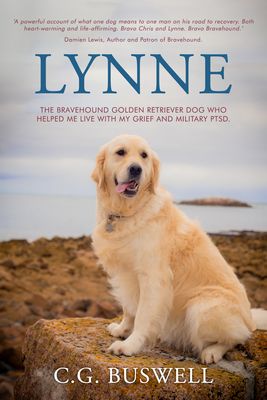
My PTSD assistance dog, Lynne, and I have written a book about how she helps me with my military Post Traumatic Stress Disorder, anxiety, and depression. I talk about my time in the QAs and the coping strategies I now use to be in my best health.
Along the way, I have had help from various military charities, such as Help for Heroes and The Not Forgotten Association and royalties from this book will go to them and other charities like Bravehound, who paired me with my four-legged best friend.
I talk openly about the death of my son by suicide and the help I got from psychotherapy and counselling and grief charities like The Compassionate Friends.
The author, Damien Lewis, said of Lynne:
"A powerful account of what one dog means to one man on his road to recovery. Both heart-warming and life-affirming. Bravo Chris and Lynne. Bravo Bravehound."
Download.
Buy the Paperback.
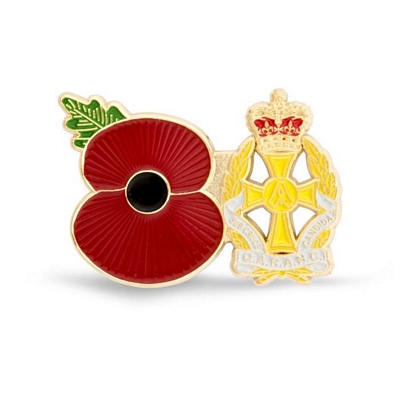
This beautiful QARANC Poppy Pin Badge is available from the Royal British Legion Poppy Shop.
For those searching military records, for information on a former nurse of the QAIMNS, QARANC, Royal Red Cross, VAD and other nursing organisations or other military Corps and Regiments, please try Genes Reunited where you can search for ancestors from military records, census, birth, marriages and death certificates as well as over 673 million family trees. At GenesReunited it is free to build your family tree online and is one of the quickest and easiest ways to discover your family history and accessing army service records.
More Information.
Another genealogy website which gives you access to military records and allows you to build a family tree is Find My Past which has a free trial.
War Diary
The war diary of Nursing Sister Sheila Cranch who served in India during the Second World War can be read on the Queen Alexandra's Imperial Military Nursing Service for India page.
The war diary of one of the QAIMNS who bravely followed our troops into Normandy and cared for our wounded right into Germany can be read on the D Day Normandy Landings page.
War Diary Entries
The following war diary entries are from the war diaries of Nursing Sister Elsie Mary Threadingham who was a QA serving from September 1939 until after the end of hostilities and her subsequent marriage in 1946:
No. 9 BGH, a small unit of 500 beds, arrived in Cherbourg on the morning of September 13th together with No.1 (Jonah) large base hospital 1000 beds, and No 4. (Betty), also a large base hospital. All three left Cherbourg station on the evening of the same day, No 1 to Dieppe and No 4 to La Baule.
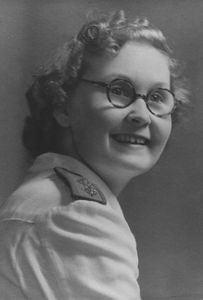
No 9 travelled through the night arriving at Le Mans early morning and moved into a small hotel for QAs only for short stay before setting up the hospital in the Chateau in the village of Le Grande Luce about 15 miles from Le Mans. The Chateau had extensive grounds where large tents were placed during the coming months being added to as the need arose, very few patients were accommodated in the Chateau, only the very ill (medical) on the ground floor (surgical) on the first floor, together with an operating theatre.
Christmas cards sent from the Royal family to the BEF printed in the King’s handwriting and signed by them both. This was sent to all ranks. The one from Queen Mary sent only to QAs with the message printed in her handwriting and by her. Queen Mary was the President.
Studio portrait was taken in Le Mans for Xmas 1939 and the Christmas card planned during the months of the “phoney war” sent from the QAs of No9 BGH (British General Hospital) – the one and only time such a thing was executed while the war lasted. The badge is that of the QAs and the ribbon the colours of the service.
Describing the location of the field hospital Sister Threadingham continues:
Chateau from the rear with the Lake and the vegetable garden, the Church in the village square, and the small house to the right of the chateau was used by night duty sisters, and the large building to the right of that the Orangery where we used to play badminton. Vera Turner, me and two Irish girls (from the south) working in London at the time of the outbreak of war joined up. I can’t remember their names, but they were very pleasant girls and excellent to work with.
During the months before Christmas a café was opened in the village square by a mother and daughter, Monique and her mother. They did not have much in the way of food, except bread, eggs and potatoes and mushrooms. And they produced mushroom omelette and chips. They were very well supported by the other ranks and QAs they were the only eating place in the village. They left for Paris early spring of 1940 and the following card was delivered by hand some weeks later. It’s addressed on the back to “Dear Miss Freddie, We think very much of you all and hope we see you all again as soon as possible” Of course they never did.
Our stay in France came to an end about the 11th June 1940 after a few very hectic weeks, I spent the last three of them in a Chateau near Evreux with two other sisters in a small detachment until while we had been operating as a CCS sending back wounded to Le Grande Luce we had to return as the Germans were rapidly approaching. We sailed back to England, sisters only.
After a few months at home after arriving back in Southampton on June 13th, I was recalled to firstly Clevenden, where I was taught to play bridge, and then to Tenby with the 32nd BGH. Betty had arrived back and Jonah also a week later, and David a few days later and we had a day together at home before he, David was recalled to Dorking. We did not meet again in England before the 32nd together with Betty’s No 9 sailed from Gourock early in August. The 32nd was on the `Empress of Canada`, N0 9 on the `Andes` both in the same convoy, we stopped off Freetown and then at Cape Town for a couple of days where Betty and I met and were entertained with others by the local ladies, mostly nursing bodies. We were also taken to see the main hospital in Cape Town. I was not allowed ashore on the second day as I had been rude to the officer in charge of troops, not knowing it was he I complained about how long we were kept hanging about before going ashore. I had to spend the day in the Sick Bay. Became very popular with the officers in the Saloon that evening as they all wanted to meet the sister who had “told the CO off” was bought more drinks than I could drink, my friends were quite happy to help me out.
We arrived early in September in Cairo and were sent to Heliopolis, a suburb of Cairo and No 9 and N0 32 lived in the Palace Hotel where No 9 stayed and No 32 went to Khartoum where we set up a hospital in a school only partly built about 15 miles distant from Khartoum on the banks of the Nile so that wounded troops, ours and Italians were brought by barge from battle in Eritrea.
Commenting on her stop in Cape Town and Simonstown Sister Threadingham wrote:
Getting back on board from Simonstown was somewhat hazardous as a rough sea was running and we had to be taken out to the ship by launch and climb up the side by rope ladder to be grabbed as we reached the top, great fun was had by all.
Elsie Mary Threadingham trained at the Royal London Hospital and worked there from November 1934 to January 1939. She left the QAs and married in 1946. She had two sons, one of whom was born at the London Hospital. Sister Threadingham continued to work in local hospitals. She died in 1991. Her eldest son, Ian Lauriston, recalls that she kept in close contact with her army colleagues and took him to visit her old haunts. Ian said:
I was sixteen at the time and remember a poignant breakfast at a small hotel in France when she got into conversation with the proprietor, telling him of her earlier time in Le Mans. I particularly recall an exchange during which he said to her “But you went away”, only for my mother to reply in her no nonsense way “yes, but we came back too”. She also made a visit to Israel sometime in the mid-eighties with her old friend and colleague Sister Jones, known only to me as Jonah, where they re-discovered some of the buildings they had used as hospitals.
Whilst her script does not mention it, after Egypt she spent some time in Eritrea, Asmara particularly features amongst her pictures, and then in what she always referred to as Palestine. She would often speak of Jerusalem, Nazareth, Bethlehem and other biblical towns. At some point in late 1943 and early 1944 she was withdrawn and returned to the UK only to return to France in July 1944 from where she followed the troops all the way to Germany, ending up in Hamburg before returning east and having responsibility for the nursing staff at a medical unit on the Belgian coast.
She always maintained that from landing in France in 1944 they were working effectively around the clock with barely any time off. Very much unlike the early days when for a while most patients were soldiers who had been driving on the wrong side of the road. There was now no time spent playing tennis, badminton or drinking in the mess or bars on weekends away, all of which feature very much amongst her photographic collection. She took very few pictures in 1944 but I remember her speaking of POW patients, some of which were committed Nazis, of strict rations introduced for POW patients for a few weeks following the discovery of the concentration camps, of having lunch/dinner in a group including Richard Dimbleby (probably in the earlier years) and of having to watch Jessie Matthews (contemporary entertainer) for a while who had made a visit to give support for the troops but had second thoughts on arrival and had to be evacuated.
Service Scrapbooks.

Former Royal Air Force Regiment Gunner Jason Harper witnesses a foreign jet fly over his Aberdeenshire home. It is spilling a strange yellow smoke. Minutes later, his wife, Pippa, telephones him, shouting that she needs him. They then get cut off. He sets straight out, unprepared for the nightmare that unfolds during his journey. Everyone seems to want to kill him.
Along the way, he pairs up with fellow survivor Imogen. But she enjoys killing the living dead far too much. Will she kill Jason in her blood thirst? Or will she hinder his journey through this zombie filled dystopian landscape to find his pregnant wife?
The Fence is the first in this series of post-apocalyptic military survival thrillers from the torturous mind of former British army nurse, now horror and science fiction novel writer, C.G. Buswell.
Download Now.
Buy the Paperback.
If you would like to contribute to this page, suggest changes or inclusions to this website or would like to send me a photograph then please e-mail me.
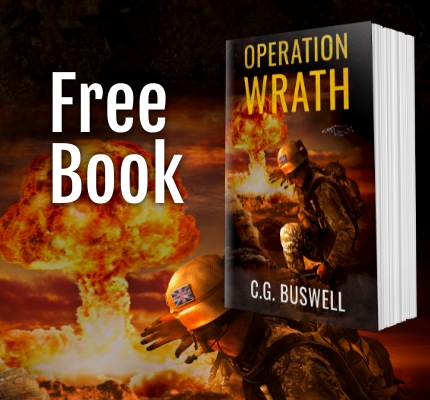
Free Book.
The death of the Brotherhood will be avenged.
RAF gunner Jason Harper and a team of Special Air Service operators are enraged after the death of their brothers by a terrorist drone strike. They fly into south-eastern Yemen on a Black-op mission to gather intelligence and avenge the death of their comrades.
Can they infiltrate the Al-Queda insurgents' camp, stay undetected, and call down their own drone missile strike and get home safely?
Will they all survive to fight another day?
Operation Wrath is a free, fast-paced adventure prequel to the non-stop action The Fence series by military veteran author C.G. Buswell.
Download for free on any device and read today.
This website is not affiliated or endorsed by The Queen Alexandra's Royal Army Nursing Corps (QARANC) or the Ministry of Defence.
» Contact
» Advertise
» QARANC Poppy Pin
» Poppy Lottery
» The Grey Lady Ghost of the Cambridge Military Hospital Novel - a Book by CG Buswell
» The Drummer Boy Novel
» Regimental Cap Badges Paintings
Read our posts on:
Offers
» Army Discounts
» Claim Uniform Washing Tax Rebate For Laundry
» Help For Heroes Discount Code
» Commemorative Cover BFPS 70th anniversary QARANC Association

Present Day
» Become An Army Nurse
» Junior Ranks
» Officer Ranks
» Abbreviations
» Nicknames
» Service Numbers
Ministry of Defence Hospital Units
» MDHU Derriford
» MDHU Frimley Park
» MDHU Northallerton
» MDHU Peterborough
» MDHU Portsmouth
» RCDM Birmingham
» Army Reserve QARANC
Photos
» Florence Nightingale Plaque
» Photographs
Uniform
» Why QA's Wear Grey
» Beret
» Army Medical Services Tartan
» First Time Nurses Wore Trousers AV Anti Vermin Battledress
» TRF Tactical Recognition Flash Badge
» Greatcoat TFNS
» Lapel Pin Badge

» Army School of Psychiatric Nursing Silver Badge
» Cap Badge
» Corps Belt
» ID Bracelet
» Silver War Badge WWI
» Officer's Cloak
» QAIMNSR Tippet
» QAIMNS and Reserve Uniform World War One
» Officer Medal
» Hospital Blues Uniform WW1
Events
» Armed Forces Day
» The Nurses General Dame Maud McCarthy Exhibition Oxford House London
» Edinburgh Fringe Stage Play I'll Tell You This for Nothing - My Mother the War Hero
» Match For Heroes
» Recreated WWI Ward
» Reunions
» Corps Day
» Freedom of Rushmoor
» Re-enactment Groups
» Military Events
» Remembrance
» AMS Carol Service
» QARANC Association Pilgrimage to Singapore and Malaysia 2009
» Doctors and Nurses at War
» War and Medicine Exhibition
» International Conference on Disaster and Military Medicine DiMiMED
» QA Uniform Exhibition Nothe Fort Weymouth
Famous QA's
» Dame Margot Turner
» Dame Maud McCarthy
» Lt Col Maureen Gara
» Military Medal Awards To QAs
» Moment of Truth TV Documentary
» Sean Beech
» Staff Nurse Ella Kate Cooke
Nursing
Nursing Jobs Vacancies UK
International Nurses Day
International Midwife Day
Info
» Search
» Site Map
» Contact
» Other Websites
» Walter Mitty Military Imposters
» The Abandoned Soldier
We are seeking help with some answers to questions sent by readers. These can be found on the Army Nursing page.
» Find QA's
» Jokes
» Merchandise
» Mugs
» Personalised Poster
» Poppy Badges
» Stamp
» Teddy Bears
» Pin Badges
» Wall Plaques
» Fridge Magnet